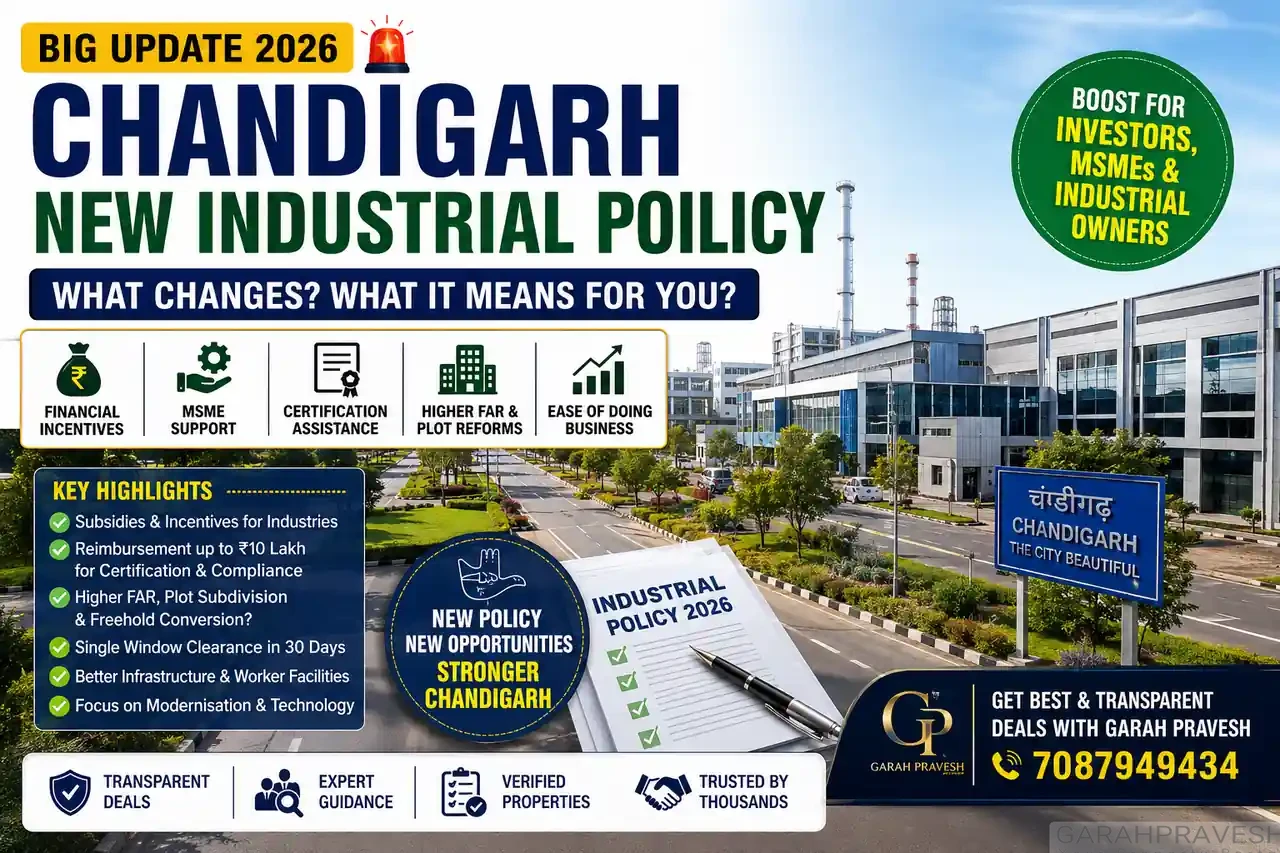
Could Chandigarh’s New Industrial Policy Finally Change the Rules for Businesses? What Investors, MSMEs and Industrial Plot Owners Need to Know in 2026
By Manoj Jangra | Garah Pravesh | July 2026
Published by: News Desk, Garah Pravesh
Topic: Chandigarh New Industrial Policy 2026
Primary Keyword: Chandigarh New Industrial Policy 2026
Short answer: The proposed Chandigarh New Industrial Policy 2026 could become a significant turning point for the city’s industrial ecosystem if the proposed incentives, regulatory reforms, MSME support, higher development potential and long-pending property reforms are eventually approved and implemented. The biggest question, however, is not only what the new policy promises—it is whether Chandigarh can successfully convert policy proposals into practical benefits for existing industries, new investors, workers and industrial property owners.
Editor’s note: This report is based on the newspaper material shared with Garah Pravesh and additional publicly available policy information. Several measures discussed below are proposals or matters under consideration and should not be treated as final government notifications unless formally approved and notified by the competent authority.
Why Chandigarh’s New Industrial Policy 2026 Matters Right Now
Chandigarh has always had a unique industrial challenge.
Unlike neighbouring Mohali, Zirakpur, Panchkula and other parts of the Tricity region, Chandigarh has extremely limited land available for fresh industrial expansion. The city’s original planning framework, strict land-use controls and scarcity of developable industrial land have created a very different operating environment for businesses.
The official Chandigarh Administration’s Industries Department itself acknowledges land availability as a constraint and notes that further industrial expansion is limited largely to the existing Industrial Area Phase I and Phase II. The Administration has also historically promoted IT, knowledge-based and relatively less space-intensive industries because of these limitations.
This is why the emerging discussion around the Chandigarh New Industrial Policy 2026 is attracting attention beyond the industrial community.
If implemented effectively, the proposed policy could influence:
- Industrial plot utilisation.
- Expansion and modernisation of existing units.
- MSME investment.
- Employment generation.
- Industrial property demand.
- Technology adoption.
- Ease of doing business.
- Compliance costs.
- Certification and regulatory expenses.
- Infrastructure in Industrial Area Phase I and II.
- The future of leasehold industrial properties.
- Floor Area Ratio, or FAR.
- Plot subdivision and land efficiency.
- The competitiveness of Chandigarh compared with Mohali and other nearby industrial destinations.
The timing is particularly important because Chandigarh is already examining broader reforms under the Centre’s deregulation agenda. Recent developments have included proposals relating to industrial plot fragmentation and more efficient use of large industrial parcels. The Administration issued an addendum in May 2026 concerning proposed amendments to the Chandigarh Master Plan-2031 relating to fragmentation of industrial plots in Industrial Area Phase I and II.
So, the question is no longer simply whether Chandigarh needs a new industrial policy.
The bigger question is:
Can the new policy deliver the reforms that the city’s industrial sector has been waiting for since 2015?
What Is the Chandigarh New Industrial Policy 2026 Expected to Focus On?
The emerging policy framework appears to be centred on a simple objective: make Chandigarh more investment-friendly while helping existing industries survive, modernise and grow within the city’s limited land resources.
The Administration is reportedly examining industrial policy models from other states, including Gujarat, while considering a package of incentives and regulatory reforms aimed at attracting investment and strengthening the existing industrial base.
One of the proposals under consideration is financial support for certain mandatory certifications and regulatory approvals.
According to the information shared in the newspaper report, industrial units spending up to approximately ₹10 lakh on eligible product certification, food and quality testing, export licences or other mandatory technical approvals could potentially receive partial reimbursement, subject to eligibility criteria and the final provisions of the policy.
This could be particularly relevant for MSMEs.
For a large corporation, certification and regulatory compliance expenses may represent a relatively small part of the overall investment. For a small manufacturing unit, however, spending several lakh rupees on testing, certification and technical approvals can become a meaningful financial burden.
A reimbursement mechanism, if formally approved, could therefore reduce the entry barrier for businesses seeking to upgrade their products or enter new markets.
However, businesses should wait for the final policy notification before assuming that a particular expense will qualify.
The actual reimbursement percentage, maximum permissible amount, eligibility conditions, application procedure and time limits will be critical.
Could New Industrial Incentives Make Chandigarh More Attractive to Investors?
Potentially, yes—but the success of the policy will depend on the final incentive structure and implementation.
The proposed Chandigarh industrial policy is expected to examine concessions relating to electricity charges, government fees and other statutory levies. The objective would be to reduce the operating cost of industrial units and make the local business environment more competitive.
For investors, this matters because the cost of running an industrial business is not limited to the purchase or lease of property.
An entrepreneur has to consider:
- Land or property cost.
- Construction and development expenses.
- Electricity and utility charges.
- Regulatory approvals.
- Labour costs.
- Compliance expenses.
- Pollution-control requirements.
- Logistics.
- Parking and worker facilities.
- Financing costs.
- Taxes and government fees.
Even modest reductions in recurring operational costs can make a difference to an MSME’s long-term viability.
But there is an important distinction between announced incentives and implemented incentives.
The industrial community in Chandigarh has already experienced the gap between policy promises and ground-level execution.
That history is one of the main reasons why stakeholders are closely watching the proposed new policy.
The official Chandigarh Industrial Policy 2015 already contained provisions covering ease of doing business, single-window systems, MSME facilitation, procurement preference, industrial development, property transfer and freehold conversion.
The new policy will therefore be judged not only by the number of new announcements it makes, but by how effectively it implements them.
Why MSMEs Could Be the Biggest Beneficiaries of Chandigarh’s New Industrial Policy
The proposed focus on Micro, Small and Medium Enterprises (MSMEs) is one of the most important aspects of the emerging policy.
Chandigarh does not have unlimited industrial land.
That makes the traditional model of attracting large, land-intensive manufacturing projects difficult to sustain.
The more realistic opportunity may lie in helping existing businesses become more productive.
This could include:
- Modernising old industrial units.
- Introducing advanced machinery.
- Adopting cleaner technologies.
- Improving energy efficiency.
- Supporting digital transformation.
- Increasing production from existing premises.
- Encouraging technology-oriented businesses.
- Supporting export-oriented enterprises.
- Improving worker skills.
- Creating stronger industrial infrastructure.
The policy discussion also reportedly includes the possibility of establishing a dedicated industrial incentive fund.
Such a fund could potentially be used to finance subsidies and incentive programmes under the new policy.
The final structure will matter enormously.
A transparent incentive fund with clearly defined eligibility criteria and time-bound approvals could provide greater certainty to investors. On the other hand, if the process remains complicated or approvals are delayed, the practical value of the incentives could be limited.
For Chandigarh’s MSMEs, predictability may ultimately be as important as the size of the incentive.
Could the New Policy Reduce the Cost of Industrial Compliance?
This is one area where the proposed policy could have a direct impact on businesses.
The newspaper report highlights the possibility of partial financial assistance for expenses related to:
- Product certification.
- Food testing.
- Quality testing.
- Export licences.
- Mandatory technical approvals.
- Other eligible regulatory requirements.
The proposed assistance could reportedly cover expenses up to approximately ₹10 lakh, subject to the final policy framework.
For businesses trying to expand from local markets to national or international markets, compliance can be a major hurdle.
Consider a small manufacturer in Chandigarh that wants to sell to a larger institutional buyer or export its products.
The company may need additional testing, certifications, quality assurance processes and regulatory documentation.
If the new policy helps reduce the financial burden of these requirements, it could encourage more businesses to formalise, upgrade and expand.
That could create a wider economic impact.
More competitive businesses can potentially mean:
Higher production → more investment → more employment → greater demand for services → stronger local economic activity.
However, this remains a potential policy outcome rather than a guaranteed result.
The reimbursement rules and implementation mechanism will determine whether the proposal actually reaches the businesses that need it most.
Why Chandigarh’s Limited Industrial Land Is Driving Policy Reform
This may be the single biggest structural issue behind the new policy.
Chandigarh cannot simply keep expanding its industrial footprint outward in the same way that some neighbouring cities can.
The city has a defined geographical boundary and a highly planned urban structure.
The result is a basic economic reality:
When new land is scarce, existing land has to become more productive.
That explains why recent policy discussions have increasingly focused on:
- Plot fragmentation.
- Higher FAR.
- Better utilisation of underused industrial land.
- Expansion of existing industrial units.
- Modernisation.
- Multiple permitted activities.
- Technology-based industries.
In May 2026, reports indicated that the Administration was considering allowing subdivision of larger industrial plots, with one proposal involving four-kanal holdings being divided into smaller units of at least one kanal, subject to applicable planning and regulatory conditions. The Administration has also been examining higher FAR for industrial plots.
The Chandigarh Administration subsequently issued an addendum to proposed Chandigarh Master Plan-2031 amendments concerning fragmentation of industrial plots in Industrial Area Phase I and II.
This is potentially significant.
A large industrial plot that is partly vacant or underutilised represents an economic opportunity that may currently be locked.
If regulations allow more efficient utilisation without compromising Chandigarh’s planning principles, the same land could potentially support more businesses, more investment and more employment.
But such reforms must be carefully planned.
Industrial intensification also brings questions about:
- Parking.
- Traffic.
- Fire safety.
- Waste management.
- Pollution control.
- Worker facilities.
- Power supply.
- Water supply.
- Effluent treatment.
- Building safety.
Therefore, higher FAR or plot subdivision cannot be considered in isolation.
The infrastructure must grow alongside the permitted development potential.
The Freehold Question: Why Industrial Plot Owners Are Watching Closely
For many existing industrial property owners, the most important issue may not be a new subsidy.
It may be ownership structure.
The demand to convert industrial plots from leasehold to freehold has been a long-running issue.
Stakeholders argue that freehold ownership can provide greater long-term certainty and flexibility, while potentially improving the ability of property owners to plan investments, obtain financing and transfer assets.
The Chandigarh Industrial Policy 2015 itself included provisions related to transfer of industrial plots from leasehold to freehold, showing that the issue has been part of the policy conversation for years.
The new policy discussion has once again brought the matter into focus.
Chander Verma, chairman of the Chandigarh Industrial Converted Plot Owners Association, has reportedly called for a policy that protects existing industries and workers, while raising concerns about commitments made under the 2015 policy.
Among the association’s demands are simplified rules for mortgage, transfer and change of use of converted MSME plots, along with the long-standing demand for leasehold-to-freehold conversion.
The Chamber of Chandigarh Industries has also reportedly argued that the new policy should implement key recommendations associated with the Centre’s deregulation exercise, including higher FAR, liberalised activities, additional incentives and freehold conversion.
These demands reflect a broader concern:
A new industrial policy cannot be only about attracting new investors. It must also protect the businesses that have already invested in Chandigarh.
That distinction is crucial.
Existing industrial units have already invested capital, created employment and built operational ecosystems.
If policy reforms focus exclusively on new investment while ignoring existing industries, the impact could be limited.
What Are Industrial Associations Asking the Chandigarh Administration to Change?
The demands emerging from industry representatives cover a broad range of issues.
One major demand is a genuine single-window clearance system.
The industry community has reportedly sought deemed approval within 30 days for eligible NOCs and permissions.
The objective is straightforward.
A business should not have to spend months or years navigating multiple departments for routine approvals when the information and documentation are already available with the government.
Other demands reportedly include simplified procedures for:
- Mortgage of converted MSME plots.
- Transfer of industrial properties.
- Change of use.
- Worker infrastructure.
- Parking.
- Toilets.
- Public transport.
- Common Effluent Treatment Plants.
- Skill development centres.
The industry community has also sought stronger support for:
- Solar energy.
- Waste management.
- Pollution-control measures.
- Local MSMEs in government procurement.
- Incubation programmes.
- Technology adoption.
Another significant proposal is the creation of an Industrial Advisory Council with representation from industrialists and workers.
The logic behind such a body is that industrial policy should not be designed in isolation.
The people operating factories, running MSMEs and working in industrial areas understand the practical problems of the sector.
Regular consultation could therefore improve policy design.
The association has also reportedly sought quarterly public reporting on policy implementation.
From a governance perspective, this is an important demand.
A policy becomes more credible when businesses can track:
- What was promised?
- What has been implemented?
- What is pending?
- Which department is responsible?
- What is the expected timeline?
That kind of transparency can help reduce uncertainty.
What Does the 2015 Industrial Policy Teach Us About the New Policy?
The answer is perhaps the most important lesson in this entire story.
Implementation matters more than announcements.
Chandigarh’s Industrial Policy 2015 was designed to address several issues, including ease of doing business, single-window clearances, MSME development, property transfers and industrial infrastructure.
The official policy document included dedicated sections on ease of doing business, strengthening the single-window system, MSMEs, procurement preference, industrial advisory mechanisms and leasehold-to-freehold property transfer.
The policy’s original vision also recognised Chandigarh’s limited land availability and emphasised revitalising industrial activity through IT-enabled, knowledge-based and high-tech industries while supporting established sectors.
Yet industrial stakeholders now argue that many commitments did not translate into the expected results.
That is why the new policy faces a credibility test.
The Administration will need to demonstrate:
Clear policy → clear rules → clear department → clear timeline → measurable implementation.
Without this chain, even a generous incentive package can remain ineffective.
Chandigarh vs Mohali: Which Industrial Market Could Gain More?
The answer depends on the type of business.
Chandigarh has the advantage of an established urban ecosystem, strong institutional presence, connectivity and an existing industrial base. However, land availability and regulatory restrictions remain significant considerations.
Mohali, meanwhile, offers a larger surrounding development ecosystem and greater scope for industrial and commercial expansion in the wider region, although the exact suitability varies significantly by location, land-use permissions and infrastructure.
For businesses that require significant additional land, expansion potential or large-scale facilities, locations around Mohali and the wider Tricity region may remain attractive.
For businesses that already operate in Chandigarh, however, policy reforms that improve the utilisation of existing industrial plots could be highly valuable.
This creates an important distinction:
Chandigarh may be more about unlocking existing industrial value.
Mohali and surrounding areas may offer more scope for outward expansion.
The emerging policy could therefore influence not only Chandigarh but the broader Tricity real estate and industrial investment market.
Any significant relaxation in industrial land-use rules, FAR, subdivision or ownership structures could potentially affect industrial property valuations.
However, property buyers should not assume that every proposed reform will automatically increase prices.
Market value depends on actual notifications, permitted use, title conditions, development potential, infrastructure and buyer demand.
Could the New Industrial Policy Affect Chandigarh’s Industrial Property Market?
Yes, potentially—but investors should separate policy speculation from confirmed legal rights.
Industrial property prices can be influenced by several factors.
If a property gains:
- Higher permissible FAR.
- Additional development rights.
- Greater permitted activity.
- Easier transfer.
- Freehold status.
- Subdivision potential.
- Better infrastructure.
then its economic utility could potentially increase.
However, a proposal is not the same as an approved right.
This is especially important for buyers looking at industrial plots, converted properties or commercial-use industrial assets.
Before purchasing, an investor should verify:
- The exact title and ownership structure.
- Whether the property is leasehold or freehold.
- Current permitted land use.
- Conversion status.
- Existing building approvals.
- FAR and coverage restrictions.
- Applicable zoning regulations.
- Pending dues or liabilities.
- Mortgage status.
- Whether proposed policy changes have actually been notified.
At Garah Pravesh, our view is simple: never pay a premium today based solely on a policy promise that may change tomorrow.
A policy proposal can create an opportunity.
But a legally notified right creates value.
That distinction is extremely important for investors.
What Could the New Policy Mean for Jobs and Employment?
The policy’s employment objective is potentially one of its most important economic dimensions.
Industrial policy should not be measured only by the number of businesses registered or the amount of investment announced.
The real test is whether it creates sustainable economic activity.
That means:
More functioning businesses → more production → more hiring → more skilled workers → stronger local economy.
The proposed emphasis on MSMEs, technology upgrades and modernisation could support employment if businesses are able to expand.
The demand for skill centres is also relevant.
Modern industry increasingly requires workers with technical and digital capabilities.
A stronger partnership between industrial units, training institutions and government agencies could potentially help close the skills gap.
Worker infrastructure is equally important.
Dedicated parking, toilets, transport facilities and other basic amenities may sound less significant than tax incentives, but they directly affect the daily functioning of industrial areas.
An industrial policy that supports both employers and workers is likely to have a stronger long-term impact.
The Bigger Tricity Impact: Why Mohali, Zirakpur and Chandigarh Investors Should Watch This Policy
For property investors across the Tricity, Chandigarh’s industrial reforms deserve attention.
The industrial economy does not stop at the city’s boundary.
A business based in Chandigarh may have employees living in Mohali, Zirakpur, Panchkula, Kharar or Derabassi.
Suppliers may operate from the wider Tricity.
Warehousing and logistics may be located outside Chandigarh.
Commercial property demand can be influenced by industrial activity.
Residential demand can also benefit indirectly from employment growth.
This creates a wider economic relationship.
If Chandigarh succeeds in modernising its industrial ecosystem, the benefits could potentially spread through the surrounding Tricity market.
For example, increased industrial activity could support demand for:
- Rental housing.
- Affordable homes.
- Premium residential properties.
- Commercial offices.
- Warehouses.
- Logistics facilities.
- Retail.
- Restaurants.
- Professional services.
However, this should be viewed as a potential second-order effect rather than an immediate guarantee.
Our View: Chandigarh Needs an Industrial Policy That Works on the Ground
From the perspective of a Tricity property and real estate professional, the direction of the proposed policy is encouraging.
But the real test will come after the headlines disappear.
Chandigarh needs a policy that answers practical questions.
How quickly will approvals happen?
How will incentives be claimed?
Who will qualify?
How will existing industries be protected?
Will freehold conversion actually happen?
Will FAR reforms become operational?
Can underutilised land be used more efficiently without damaging Chandigarh’s planning character?
Will MSMEs receive genuine handholding?
Will policy implementation be publicly monitored?
These are the questions that will determine whether Chandigarh gets another policy document—or a genuine industrial transformation.
My view is that the most valuable reforms would be those that combine ease of doing business with accountability.
Businesses need fewer approvals, but they also need predictable approvals.
Investors need incentives, but they also need clarity.
Industrial owners need property rights, but they also need transparent rules.
Workers need employment, but they also need infrastructure and dignity.
If the new policy can balance these priorities, Chandigarh could potentially strengthen its position as a high-value, knowledge-driven and modern industrial ecosystem.
What Should Businesses, Industrial Owners and Investors Do Now?
If you are an industrial property owner, entrepreneur or investor, this is the time to monitor developments carefully—but not to make decisions based only on rumours.
1. Track the final notification
Do not assume that every proposal discussed in media reports will become part of the final policy.
Wait for official notifications and detailed implementation guidelines.
2. Review your existing property documents
Industrial property owners should understand their current ownership structure, lease conditions, conversion status, permitted use and development rights.
3. Calculate your expansion potential
If FAR, subdivision or activity norms change, the economics of an existing industrial property could potentially change significantly.
However, the calculation should be based on the final notified rules.
4. Compare Chandigarh with the wider Tricity
Businesses planning expansion should compare Chandigarh with Mohali, Zirakpur, Derabassi and other nearby locations based on land cost, infrastructure, labour availability, connectivity and permitted use.
5. Take professional advice before investing
A proposed policy is not a substitute for legal due diligence.
Before purchasing industrial or converted property, verify title, land use, approvals and applicable government rules.
Frequently Asked Questions About Chandigarh New Industrial Policy 2026
1. What is the Chandigarh New Industrial Policy 2026?
The proposed Chandigarh New Industrial Policy 2026 is an emerging policy framework intended to strengthen industrial activity, attract investment, support existing industries and MSMEs, reduce operational and compliance burdens and improve ease of doing business. Several measures remain under consideration and should be treated as proposals until formally notified.
2. Will Chandigarh provide financial assistance for industrial certifications?
A proposal under consideration could provide partial reimbursement for eligible expenses relating to product certification, food and quality testing, export licences and mandatory technical approvals. The newspaper report shared with Garah Pravesh indicates that expenses up to approximately ₹10 lakh may be considered for assistance, subject to eligibility and final policy provisions. Businesses should wait for official guidelines before assuming eligibility.
3. Will industrial plots in Chandigarh become freehold?
Freehold conversion is a long-standing demand of industrial stakeholders and is reportedly among the issues being raised in the current policy discussions. However, investors should not assume that all leasehold industrial plots will automatically become freehold. Any such change would depend on the final policy, applicable approvals and formal government notification.
4. Could FAR for Chandigarh industrial plots increase?
Higher FAR has been discussed as part of wider industrial and deregulation reforms. Reports in 2026 have also indicated that the Administration has been considering increased FAR and more efficient use of industrial plots. The exact permissible FAR, conditions and applicability must be confirmed through final notified regulations.
5. Can large industrial plots in Chandigarh be subdivided?
The Administration has been examining fragmentation of larger industrial plots as part of efforts to improve land utilisation. Proposed amendments concerning fragmentation in Industrial Area Phase I and II have been reported in 2026. However, subdivision remains subject to applicable planning, zoning and regulatory conditions.
6. Will the new policy benefit existing industries or only new investors?
The stated policy direction includes strengthening existing industries, modernisation and technology upgrades, particularly because Chandigarh has limited industrial land. Industry associations have also stressed that the policy should protect existing businesses and workers rather than focus exclusively on attracting new investment.
7. Why is Chandigarh considering a new industrial policy after the 2015 policy?
The 2015 policy already addressed several industrial issues, including ease of doing business, MSME support, single-window mechanisms and property-related matters. Industry stakeholders have argued that several commitments were not fully implemented. The new policy therefore represents an opportunity to revisit the framework and focus more strongly on implementation.
8. Could the new industrial policy increase Chandigarh industrial property prices?
It could potentially influence property values if reforms such as freehold conversion, higher FAR, broader permitted activities or subdivision are formally approved and implemented. However, price increases are not guaranteed. Buyers should base decisions on current legal rights and notified regulations rather than speculative expectations.
9. How could Chandigarh’s industrial reforms affect Mohali and the Tricity?
Chandigarh’s industrial economy is closely connected with Mohali, Zirakpur, Panchkula and the wider Tricity. If industrial investment and employment increase, the impact could potentially extend to housing, rentals, commercial property, logistics and services across the region. The extent of the impact will depend on actual policy implementation.
10. Where can buyers and investors find transparent property deals in the Tricity?
Buyers and investors looking for property opportunities across Chandigarh, Mohali, Zirakpur and the wider Tricity can connect with Garah Pravesh for transparent property discussions and deal assistance. However, every property transaction should still involve independent title verification, legal due diligence and confirmation of applicable government approvals.
Final Word: The Real Story Is Not the Announcement—It Is What Happens Next
The proposed Chandigarh New Industrial Policy 2026 comes at a critical time.
The city has limited industrial land, an established industrial base and a growing need to modernise its economic ecosystem.
The policy discussion around incentives, MSMEs, certification support, electricity concessions, industrial infrastructure, FAR, plot fragmentation, technology upgrades and freehold conversion could potentially reshape the future of Chandigarh’s industrial sector.
But the industry’s message is equally clear:
This time, implementation must match the promise.
For businesses, investors and industrial property owners, the coming months will be important.
The final policy notification, implementation rules and approval process will determine whether Chandigarh moves toward a more flexible and competitive industrial ecosystem—or simply adds another policy document to its history.
For readers tracking Chandigarh industrial property, industrial plots, MSME investment, commercial real estate and Tricity property opportunities, this is a story worth following closely.
For transparent property deals and market guidance across the Tricity, connect with Garah Pravesh at 7087949434.
Published by News Desk, Garah Pravesh
Disclaimer
Disclaimer: This article has been prepared for general informational and news-reporting purposes based on the source material provided and publicly available information. The Chandigarh New Industrial Policy 2026 and several reforms discussed in this report may involve proposals, consultations or policy measures that are subject to final approval, notification and implementation. Readers should independently verify all policy provisions, incentives, property rights, FAR rules, land-use permissions, freehold conversion provisions and other regulatory matters through official government sources before making any business, property or investment decision. Garah Pravesh and the author do not accept legal, financial or transactional responsibility for decisions taken solely on the basis of this article. Professional legal, tax, financial and property advice should be obtained wherever appropriate.