Mohali Commercial Property Boom: GMADA Auction Takes Land Prices to ₹87.18 Crore Per Acre — What It Means for Investors, Builders and the Future of Mohali
Mohali Commercial Property Has Entered a New Phase — And the Auction Numbers Tell the Story
There was a time when investors in Mohali asked a simple question:
“Mohali mein property kitne mein mil rahi hai?”
Today, the more important question is becoming:
“Mohali mein prime commercial land kitne mein milegi?”
The difference between these two questions tells you how dramatically the market is changing.
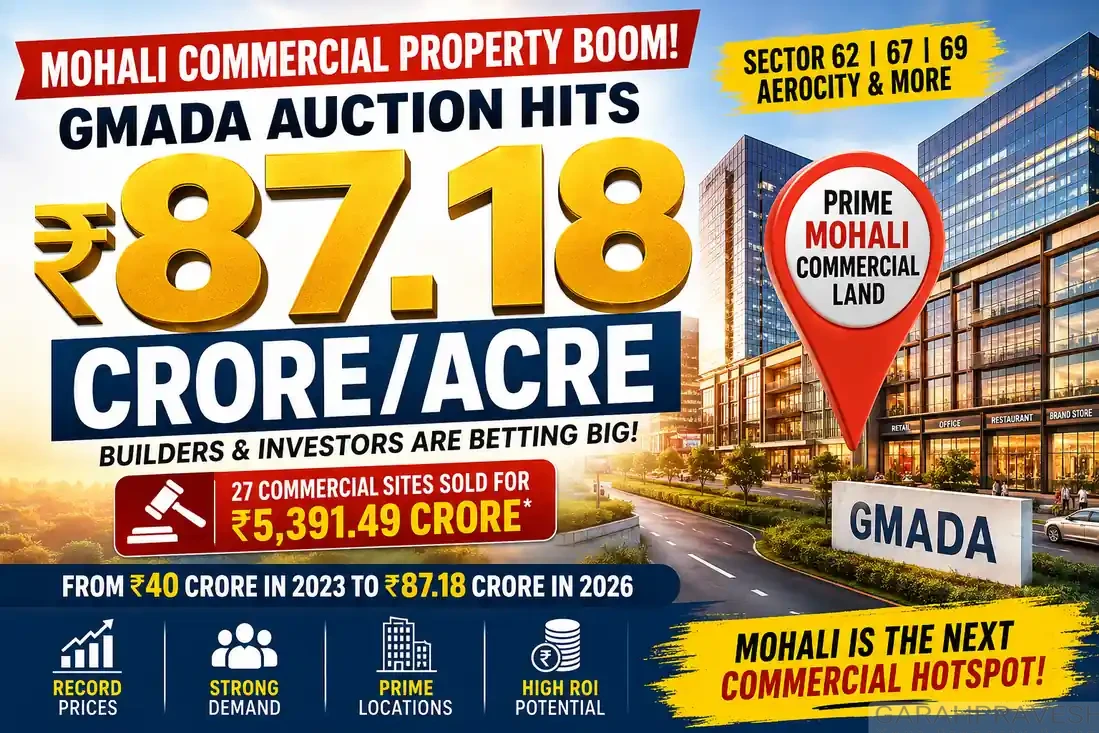
Recent GMADA commercial land auctions have produced numbers that would have sounded extraordinary only a few years ago. According to the auction figures reported in the August 2026 newspaper coverage reviewed for this article, commercial land values in key Mohali locations have climbed from roughly ₹40 crore per acre levels to around ₹87.18 crore per acre, while individual prime commercial sites have attracted bids running into hundreds of crores.
One of the biggest headline numbers is a ₹87.18 crore-per-acre rate achieved for a commercial site.
But the bigger story is not one auction.
The bigger story is the direction of the market.
The auction data shows that developers, investors and businesses are willing to pay a substantial premium for commercially usable land in locations where connectivity, catchment, visibility, planned development and future demand come together.
And that changes the investment conversation around Mohali.
GMADA itself continues to conduct e-auctions for commercial, mixed-use, institutional, residential and other categories of sites across SAS Nagar/Mohali. Its official zoning resources also cover key sectors including 62, 64, 66, 67 and 69, underlining the importance of these planned sectors within the wider development framework.
So, is Mohali becoming the next major commercial real-estate story of the Tricity?
The latest numbers suggest that investors certainly think there is a strong case.
The Number That Has Changed the Conversation: ₹87.18 Crore Per Acre
The most striking figure from the latest auction coverage is the reported ₹87.18 crore per acre achieved for a commercial site.
To understand why this number matters, don’t look at it in isolation.
Look at the trajectory.
The newspaper data highlighted commercial land transactions across 2023, 2024, 2025 and 2026.
Among the reported benchmarks:
- March 2023 — Aerocity commercial: around ₹40.76 crore per acre
- September 2024 — Sector 62 Site-2: around ₹55.85 crore per acre
- September 2024 — Sector 62 Site-1: around ₹79.38 crore per acre
- March 2025 — Aerocity mixed-use: around ₹99.17 crore per acre
- March 2026 — Sector 62 mixed-use: around ₹46.38 crore per acre
- March 2026 — Aerocity multi-use commercial: around ₹50.36 crore per acre
- Latest auction benchmark highlighted in the report: around ₹87.18 crore per acre
The numbers don’t form a straight upward line — and that is important.
Real estate auctions are highly location-specific. Plot size, permissible use, road frontage, zoning, development potential, location within a sector and competition among bidders can dramatically alter the final price.
But the broader pattern is unmistakable:
Prime commercial land in Mohali is attracting dramatically higher bids than it did a few years ago.
That is the real story.
GMADA Commercial Auction: ₹5,391.49 Crore From 27 Sites
The second newspaper report puts the scale of the latest auction activity into perspective.
GMADA reportedly sold 27 commercial sites for approximately ₹5,391.49 crore, against a combined reserve price of roughly ₹3,872.85 crore.
That means the auction generated a substantial premium over the reserve value.
In other words, buyers were not simply accepting government-set reserve prices.
They were competing.
And competitive bidding is one of the clearest indicators of market sentiment.
When a property is offered at a reserve price and receives one bid, the final price may tell us relatively little.
When multiple serious buyers compete for strategically located commercial land, the final auction price becomes a much stronger signal of what capital is willing to pay for access to that location.
The reported figures therefore deserve attention not only from property investors but also from:
- Developers
- Retail operators
- Commercial property owners
- HNIs
- Land investors
- Institutional investors
- NRI investors
- Local entrepreneurs
- Real estate consultants
- Builders looking for future commercial inventory
Why Are Investors Paying So Much for Mohali Commercial Land?
The answer is not simply “property prices are increasing.”
That explanation is too simplistic.
The real reason is that land is becoming more valuable when multiple demand drivers converge around it.
Mohali has several of those drivers.
1. Planned Urban Development
Unlike unplanned peripheral markets, large portions of Mohali have been developed through planned sector-based development.
This creates a different commercial environment.
Road networks, sector planning, institutional areas, residential sectors, commercial pockets and mixed-use zones create the possibility of concentrated economic activity.
GMADA’s zoning and layout resources cover numerous important sectors, including Sector 62, 64, 66, 67 and 69.
For a commercial investor, planning matters.
A piece of land isn’t valuable merely because it exists.
It is valuable because of what can legally and commercially be built around it.
2. Connectivity Is Becoming a Pricing Multiplier
The modern commercial property market is increasingly driven by accessibility.
Businesses want customers.
Employees want convenience.
Retailers want visibility.
Investors want liquidity.
Developers want future demand.
That makes road connectivity one of the biggest pricing factors.
The newspaper report specifically highlights the importance of connectivity and prime location in explaining the strong response to some of the latest auction sites.
This is particularly relevant for the wider Mohali growth belt, where the commercial story is increasingly connected with:
- Chandigarh
- Airport Road
- Aerocity
- IT City
- Sector 62
- Sector 67
- Sector 69
- Sector 66
- Sector 82
- Sector 83
- Aerotropolis
- New Chandigarh
- Zirakpur and the wider Tricity market
A commercial plot positioned close to major movement corridors can have a completely different economic profile from a similar-sized plot hidden inside a low-traffic location.
That is why “price per acre” should never be the only metric investors use.
Sector 62: Why the Market Is Paying Attention
Sector 62 has emerged repeatedly in the auction data.
The latest newspaper coverage mentions a 6.37-acre commercial/mixed-use site in Sector 62 that reportedly sold for ₹555.33 crore.
The reported calculation works out to approximately ₹87.18 crore per acre.
That is an extraordinary headline number.
But it becomes even more interesting when placed against previous Sector 62 transactions.
The newspaper data records earlier Sector 62 benchmarks around:
- ₹55.85 crore per acre
- ₹79.38 crore per acre
before the latest ₹87.18 crore-per-acre benchmark.
This does not mean every property in Sector 62 is worth ₹87 crore per acre.
That would be an incorrect interpretation.
Auction pricing is specific to the individual property.
But it does demonstrate something important:
Strategically positioned commercial land in Sector 62 has attracted increasingly aggressive valuations.
For investors, that makes Sector 62 one of the areas worth tracking closely.
Sector 67: Another Commercial Price Signal
Sector 67 is another location that deserves attention.
The latest auction coverage reports a 2.59-acre commercial site in Sector 67 selling for ₹225.79 crore.
Again, the resulting rate is reported at approximately ₹87.18 crore per acre.
This is significant because smaller commercial parcels can sometimes command extraordinary per-acre rates.
Why?
Because the investor is not necessarily buying “acres”.
The investor is buying:
location + frontage + visibility + permitted use + development potential + future customer catchment.
This is a crucial distinction for anyone trying to understand Mohali commercial property prices.
A 2.59-acre commercial site cannot be evaluated in exactly the same way as a 27-acre mixed-use parcel.
The development economics are different.
Sector 69: SCO Market Shows a Different Kind of Demand
The auction data also highlights strong bidding for smaller commercial formats such as SCO sites.
Among the reported top auction results:
- A Sector 69 SCO site reportedly reached around ₹347.83 crore per acre equivalent
- Another Sector 64 SCO site was reported around ₹321.18 crore per acre equivalent
- Several Sector 69 SCO sites crossed the ₹300 crore-per-acre equivalent level
At first glance, these numbers may appear to contradict the ₹87.18 crore-per-acre figure.
They don’t necessarily.
The reason is the nature of the property.
An SCO is not directly comparable with a large raw commercial or mixed-use land parcel.
The “per-acre equivalent” calculation for small SCO sites can produce very high numbers because the land parcel is small and the commercial development potential is concentrated.
This is exactly why investors should avoid comparing commercial properties purely on an acre-to-acre basis.
For smaller commercial formats, the more relevant questions are:
- What is the plot size?
- What is the permissible FAR?
- What floors can be constructed?
- What is the frontage?
- What is the road width?
- What is the permitted commercial use?
- What is the parking requirement?
- What is the expected rental potential?
- What is the expected capital appreciation?
- What is the total development cost?
The ₹5,391 Crore Auction Is More Important Than One Record Price
It is tempting to build the entire story around ₹87.18 crore per acre.
But the larger signal is the reported ₹5,391.49 crore auction value across 27 commercial sites.
Why?
Because one extraordinary transaction can always be an outlier.
Twenty-seven sites generating thousands of crores provides a much broader view of demand.
According to the newspaper report, the combined reserve price was approximately ₹3,872.85 crore, while the final sale value reached around ₹5,391.49 crore.
That represents a substantial increase over the reserve value.
For the market, this suggests that there was significant competition for the offered commercial inventory.
And this is where the story becomes particularly interesting for builders.
Builders Are Not Just Buying Land — They Are Buying Future Commercial Cash Flow
A developer purchasing commercial land at a high price is making a very different calculation from a residential investor buying a plot.
The developer is asking:
What can this land produce?
For example:
A commercial parcel may ultimately generate value through:
- Retail
- Office space
- Food and beverage
- Clinics
- Restaurants
- Banks
- Showrooms
- Corporate offices
- Hospitality
- Co-working
- Service businesses
- High-street retail
- Rental income
- Sale of commercial units
The land price is therefore only the beginning of the development equation.
A developer can potentially justify a higher land acquisition cost if the location supports high-value development and strong absorption.
This is one reason why prime commercial auctions can reach prices that appear astonishing compared with nearby residential land.
Commercial property is ultimately priced against income-generating potential, not just land area.
Why Commercial Property Can Outperform Residential Property in the Right Location
Residential property usually has a relatively straightforward demand driver:
People need homes.
Commercial property has another layer:
Businesses need profitable locations.
If a location generates enough consumer traffic, office demand or business activity, the underlying land can become extremely valuable.
Consider a high-street retail location.
A retailer may be willing to pay significantly more for a location where:
- thousands of people pass daily,
- nearby residential density is increasing,
- parking is available,
- road visibility is strong,
- competing brands are already present,
- surrounding infrastructure is improving.
The same piece of land may be worth considerably less if those factors do not exist.
That is why Mohali’s commercial property story should be understood through economic activity, not simply property speculation.
Aerocity: The Other Major Piece of the Puzzle
The auction data also includes several Aerocity commercial and mixed-use benchmarks.
The newspaper’s historical comparison shows:
March 2023 Aerocity commercial — approximately ₹40.76 crore per acre
and later Aerocity mixed-use/commercial transactions reaching considerably higher levels.
Aerocity is strategically important because its investment thesis is closely linked to the airport-road ecosystem and the broader expansion of Mohali’s urban footprint.
For investors, the important question isn’t merely:
“Is Aerocity expensive?”
The better question is:
“Which part of Aerocity has the strongest combination of connectivity, development readiness, commercial visibility and future demand?”
This distinction can create significant differences between two properties that appear geographically close.
What the Auction Means for Mohali Property Prices
The biggest misconception investors can make is to assume:
“GMADA auction price = market price for every property nearby.”
That is not correct.
Auction prices are benchmarks, not universal price lists.
A government-auctioned commercial plot may have:
- superior location,
- better frontage,
- larger development potential,
- stronger zoning,
- better road access,
- greater visibility,
- better commercial use,
- fewer competing properties.
Therefore, nearby privately held land may trade at a different rate.
However, auction results can still create an important psychological and financial benchmark.
When a nearby government commercial site sells at a record price, landowners naturally reassess their expectations.
That can influence:
- Asking prices
- Negotiation ranges
- Investor expectations
- Developer acquisition strategies
- Rental expectations
- Future auction reserve prices
This is how auction discoveries gradually filter into the broader property market.
A New Question for Investors: Is Mohali Still Affordable?
This is perhaps the most interesting question.
If commercial land is already reaching ₹87.18 crore per acre in prime locations, should investors be worried that they have missed the opportunity?
Not necessarily.
Real estate rarely moves uniformly.
A city can simultaneously contain:
- extremely expensive prime commercial land,
- moderately priced emerging commercial land,
- undervalued residential land,
- early-stage development corridors,
- future commercial nodes.
The investment opportunity therefore shifts.
Instead of chasing yesterday’s record location, smart investors start identifying tomorrow’s commercial location.
That is where the real opportunity may lie.
Where Could the Next Commercial Growth Come From?
The answer will depend on infrastructure, zoning, development pace and actual business demand.
But the broader Mohali growth story puts several areas on the radar.
Sector 62
Already demonstrated strong commercial demand and significant auction activity.
Sector 67
A major commercial benchmark has emerged here, particularly for smaller prime commercial land.
Sector 69
The SCO market has shown extremely aggressive bidding.
Sector 66 / 66A
Part of the larger mixed-use and IT-oriented ecosystem.
Sector 82 / 83
Important because of the IT City and surrounding development ecosystem.
Aerocity
A major growth corridor where airport connectivity and planned development remain important components of the investment story.
Aerotropolis
A longer-term development story that investors should monitor carefully rather than treating future potential as guaranteed appreciation.
GMADA’s current public information also reflects continuing planning and land-acquisition activity connected with Aerotropolis and other development areas.
Why Smaller Commercial Plots Are Getting So Much Attention
The newspaper coverage makes another important observation:
Small commercial plots are attracting strong buyer interest.
This is logical.
A small commercial property can be more accessible to:
- Local businessmen
- Retail investors
- HNIs
- Doctors
- Professionals
- Restaurant operators
- Franchise owners
- Small developers
It can also have a clearer end-use strategy.
For example, a small SCO may be developed into a focused commercial building rather than a large mixed-use project requiring hundreds of crores in development capital.
That can increase the pool of potential buyers.
However, small plots also require careful due diligence because construction restrictions, parking, FAR, access and building regulations can materially affect the economics.
The Hidden Story Behind Record Auctions: Scarcity
One of the most important principles of real estate is simple:
You cannot manufacture prime land.
You can build more apartments.
You can build more offices.
You can build more shops.
But if a particular location has limited commercially designated land with strong road frontage and high visibility, its scarcity can become a major pricing factor.
This is particularly relevant in planned urban sectors.
When commercial inventory is limited but residential catchment and business activity continue to grow, competition for the best sites can intensify.
That is when auctions can produce surprising numbers.
What Should Investors Look for Before Buying Mohali Commercial Property?
Record auction prices should create interest.
They should not create FOMO.
Before buying any commercial property in Mohali, investors should examine at least these 12 factors.
1. Exact Location
Do not buy based only on the sector name.
A property on a prime road and another property several hundred metres away can have very different economics.
2. Zoning
Confirm exactly what the property is permitted to be used for.
3. FAR and Building Potential
Land value without development potential can be misleading.
4. Road Width
Access and visibility directly affect commercial viability.
5. Frontage
For retail, frontage can be more important than investors initially realise.
6. Parking
A beautiful commercial building without adequate parking can struggle commercially.
7. Catchment
Study surrounding residential and office population.
8. Competition
A market can be successful and still become oversupplied.
9. Rental Potential
Calculate realistic rent rather than assuming optimistic future figures.
10. Development Cost
Land is not the complete investment.
Construction, approvals, financing, services, fit-outs and holding costs must be included.
11. Exit Liquidity
Ask who will buy your property five years later.
12. Legal and Regulatory Due Diligence
Title, approvals, zoning, building permissions, dues and applicable authority conditions must be verified before committing capital.
₹87.18 Crore Per Acre Does Not Mean Prices Will Double Tomorrow
This needs to be said clearly.
Real estate headlines can create excitement, but serious investors must distinguish between:
transaction data and investment guarantees.
A record auction demonstrates what a buyer paid for a specific asset under specific circumstances.
It does not guarantee:
- 20% annual appreciation,
- doubling of prices,
- immediate rental growth,
- guaranteed resale,
- guaranteed project success.
Commercial property is particularly sensitive to economic cycles.
Interest rates, business expansion, retail demand, construction costs, consumer spending and infrastructure execution can all influence future returns.
The correct conclusion from the latest auction is therefore not:
“Mohali commercial property will definitely double.”
The more defensible conclusion is:
“Prime Mohali commercial land is attracting significantly higher capital commitments, and investors should pay closer attention to the locations driving that demand.”
What Does This Mean for NRI Investors?
For NRIs, Mohali’s commercial property story is particularly interesting because the market offers exposure to a city with strong Tricity connectivity and a growing business ecosystem.
But NRI investors should be even more disciplined.
A remote investment should not be made purely from a WhatsApp listing or an attractive projected return.
Before investing, an NRI should ideally understand:
- Ownership structure
- Title
- Authority approvals
- Zoning
- Development potential
- Rental demand
- Property management
- Tax implications
- Financing
- Exit strategy
The best NRI investment is not necessarily the property with the biggest headline appreciation.
It is the property where the numbers, documentation and exit strategy make sense together.
The Bigger Tricity Story
Mohali should also not be analysed in isolation.
The real market is increasingly the Chandigarh–Mohali–Zirakpur Tricity economic region.
Businesses don’t necessarily care about municipal boundaries.
They care about:
- customers,
- employees,
- connectivity,
- accessibility,
- infrastructure,
- business ecosystem,
- commercial visibility.
That creates a broader real-estate ecosystem.
Chandigarh remains the established premium market.
Mohali has developed as a major planned expansion and business centre.
Zirakpur has grown rapidly as a high-connectivity residential and commercial market.
The next stage of Tricity real estate may therefore increasingly be about how these markets interact.
Is This the Beginning of a New Mohali Commercial Cycle?
Possibly — but the answer will ultimately depend on whether the demand behind these auctions translates into actual economic activity.
That means investors should watch what happens next.
The most important indicators will be:
More commercial auctions
If future auctions continue attracting aggressive bidding, confidence in the market will strengthen.
More construction
Land prices are one thing.
Actual development is another.
More businesses
Restaurants, offices, retail brands, hospitals, hotels and service businesses occupying commercial space would indicate genuine economic absorption.
Rental growth
Capital appreciation without rental demand can eventually create valuation pressure.
Infrastructure delivery
Roads and connectivity must keep pace with development.
Residential growth
Commercial demand generally follows population and purchasing power.
If these indicators continue moving in the same direction, Mohali’s commercial story could become considerably larger.
The Real Opportunity May Not Be in Chasing the Record
This is perhaps the most important takeaway from the entire auction story.
When a market makes headlines with a record price, many investors immediately start searching for the next record.
That can be dangerous.
Smart investors ask a different question:
“Where is the next location that has the fundamentals that created today’s record?”
That means studying:
- Connectivity
- Planned development
- Commercial zoning
- Residential catchment
- Employment generation
- Institutional development
- Infrastructure
- Supply constraints
- Future road networks
- Developer activity
The objective is not to buy the most expensive property.
The objective is to identify the property whose future utility is likely to grow faster than its current price reflects.
What the Latest GMADA Auction Tells Us About Mohali
If we step back from the individual numbers, five conclusions stand out.
1. Commercial demand is strong
The reported sale of 27 commercial sites for roughly ₹5,391.49 crore is a significant signal.
2. Reserve prices are not necessarily the final story
Strong competition can push auction prices substantially above reserve levels.
3. Prime locations are commanding a scarcity premium
Sector 62, Sector 67, Sector 69 and other strategically positioned commercial locations have demonstrated this in different ways.
4. Smaller commercial properties can attract extraordinary valuations
SCOs and other small-format commercial sites can command very high effective land rates when location and development potential are strong.
5. Mohali’s commercial real estate market deserves serious attention
The market has moved beyond being simply a residential expansion story.
It is increasingly becoming a commercial and business growth story.
What Could Happen Next?
The next phase could be even more interesting.
As Mohali’s urban footprint expands, commercial demand could gradually move from established sectors into emerging corridors.
Developers will look for the next opportunity.
Retailers will follow consumer density.
Businesses will follow connectivity and talent.
Investors will follow transaction evidence.
And government auctions will continue providing important price-discovery signals.
That could create a fascinating cycle:
Infrastructure → Residential Growth → Population → Business Demand → Commercial Development → Higher Land Values → More Investment.
The question is not whether every location will benefit.
It won’t.
The question is:
Which locations will become the strongest links in that chain?
Final Verdict: Mohali’s Commercial Property Story Is Getting Bigger
The latest GMADA auction numbers are more than a collection of large numbers.
They are a snapshot of changing investor confidence.
A reported commercial land benchmark of ₹87.18 crore per acre, a ₹555.33 crore transaction for a 6.37-acre Sector 62 site, a ₹225.79 crore transaction for a 2.59-acre Sector 67 site, and an overall reported auction value of approximately ₹5,391.49 crore from 27 commercial sites together create a powerful picture.
Mohali’s commercial market is attracting serious money.
And perhaps the most important point is that this is happening across multiple formats — large commercial parcels, mixed-use land and smaller SCO-style properties.
For builders, the message is clear:
Prime commercial land is becoming increasingly expensive, so location selection and project economics will matter more than ever.
For investors:
Don’t chase the headline. Study the next growth corridor.
For property owners:
Understand what comparable authority auctions are doing to your asset’s benchmark value.
For buyers:
Do not confuse an auction record with a guaranteed return.
And for Mohali itself:
The city is increasingly proving that its real-estate story is not only about where people live — it is about where businesses want to be.
The ₹87.18 crore-per-acre headline may eventually be surpassed.
The more important question is not when.
It is:
Which Mohali location will produce the next big commercial real-estate surprise?
Frequently Asked Questions
What is the latest commercial property rate in Mohali?
Recent GMADA auction data reported in August 2026 indicates that prime commercial sites have achieved rates of around ₹87.18 crore per acre, although actual market rates vary substantially by sector, plot size, zoning, frontage, road connectivity and development potential.
Which Mohali sectors are seeing strong commercial demand?
Sector 62, Sector 67 and Sector 69 feature prominently in recent auction results. Aerocity and other planned growth corridors are also important areas to monitor.
What was the highest reported commercial land rate?
The latest newspaper coverage reviewed for this article reports approximately ₹87.18 crore per acre for prominent commercial transactions.
How much did GMADA reportedly earn from the latest 27 commercial sites?
The reported auction value was approximately ₹5,391.49 crore, compared with a combined reserve price of around ₹3,872.85 crore.
Is ₹87.18 crore per acre the market rate for all Mohali commercial land?
No. It is an auction benchmark for specific properties. It should not be treated as a universal market rate.
Is Mohali commercial property a good investment?
It can be attractive when the property has strong location fundamentals, commercial zoning, development potential, rental demand and a realistic acquisition price. Investors should conduct complete legal, technical and financial due diligence before purchasing.
Should investors buy commercial property after seeing these auction results?
The auction results should encourage research, not FOMO. Investors should compare the acquisition price with realistic rental income, development costs, liquidity and future demand.
Garah Pravesh Property Insight
At Garah Pravesh, we believe property investment should be based on more than a price quote.
The real question is always:
What is driving the price today — and what will drive the value tomorrow?
Mohali’s latest commercial auction results provide an excellent example.
The strongest opportunities may not necessarily be the properties making today’s headlines.
They may be the locations where infrastructure, connectivity, population, employment and commercial demand are beginning to converge.
That is where investors should be looking next.
Call / WhatsApp – +91-7087949434
Garah Pravesh — Your Property Portal
Market note: Auction figures quoted in this article are based on the August 2026 auction/reporting material reviewed for this story. Auction prices relate to specific properties and should not be interpreted as a blanket market rate for every property in the respective sector. Property buyers should independently verify title, zoning, approvals, development rights, applicable authority conditions, taxes, charges and other legal/financial matters before investing.