Chandigarh Master Plan 2031: Industrial Plot Fragmentation Explained — What It Means for Investors, MSMEs, and Plot Owners in 2026
By Manoj Jangra, Garah Pravesh | Tricity Real Estate Expert | Updated: May 2026
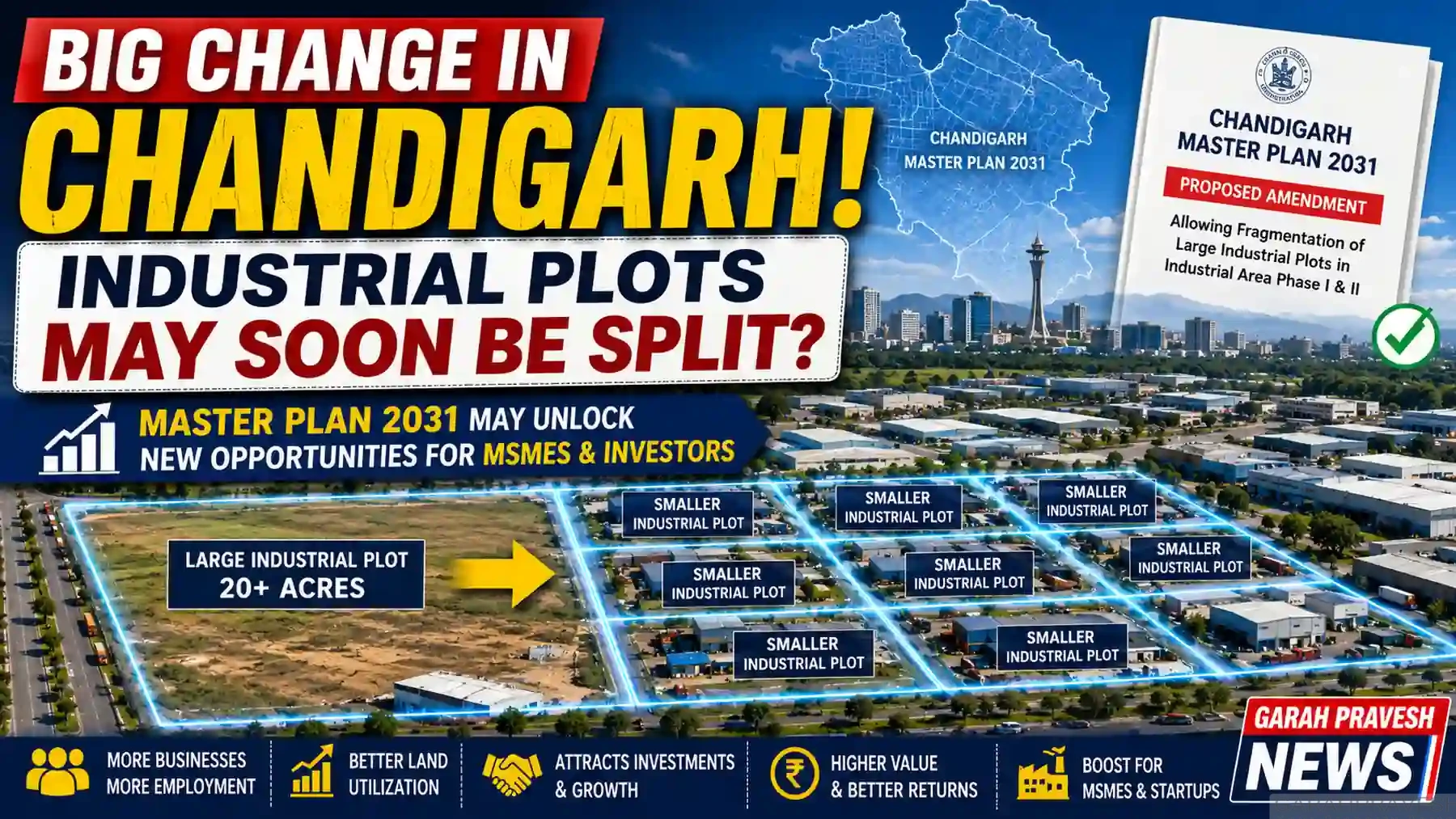
The Chandigarh Administration has approved a proposal to allow large industrial plots in Industrial Area Phase I and Phase II to be subdivided into smaller units — a reform that hasn’t happened in decades. If you own industrial land in Chandigarh, or you’ve been waiting on the sidelines because the entry costs were too high, this is the development you need to understand properly.
This isn’t just a headline. At Garah Pravesh, we’ve been tracking Chandigarh’s industrial real estate for years, advising buyers and sellers across Sector 82, Phase I, and Phase II. Here is our on-the-ground read of what this amendment actually changes, what it doesn’t, and what smart investors should do right now.
The Problem This Amendment Is Solving
Walk through Industrial Area Phase I or Phase II today and you’ll notice something: large, partially empty plots sitting behind locked gates. Chandigarh’s industrial zones were designed in an era of large-scale manufacturing, when a single factory might need 10 to 20 acres. That model is obsolete.
Today’s industrial demand looks completely different:
- A precision engineering unit needs 500–1,000 sq yards, not 5 acres
- A tech-enabled warehousing startup needs a small, well-located unit with good connectivity
- An MSME fabrication unit doesn’t have ₹20–30 crore to acquire a full industrial parcel
The result? A mismatch between what the market needs and what Chandigarh’s zoning allows. Large plots sit underutilized. MSMEs get priced out. New industrial entrants look to Mohali, Derabassi, or Baddi instead.
The proposed amendment under Chapter 16 of Master Plan 2031 directly targets this mismatch by allowing fragmentation of large industrial plots.
What the Amendment Actually Proposes
The Planning Committee, headed by the Punjab Governor and Chandigarh Administrator, has approved in principle that large industrial plots in Phase I and Phase II may be subdivided into smaller operational units.
The key word is “in principle.” A detailed operational policy is still awaited. Until that notification is released, here is what we know and what remains unclear:
What’s confirmed:
- The amendment covers Industrial Area Phase I and Phase II
- Large plots can potentially be subdivided
- The intent is to enable MSMEs and new industrial entrants to access industrial land
What’s still to be notified:
- Minimum plot size after subdivision (this is critical — the floor size determines who can actually participate)
- Maximum number of fragments allowed per parent parcel
- Building and parking regulations for subdivided plots
- Administrative approval process and fees
- Whether subdivision affects FAR (Floor Area Ratio) calculations
Until the detailed policy notification, no fragmentation can legally proceed. Plot owners should not take any action based on the approval-in-principle alone.
Why This Matters for Industrial Property Prices
Industrial real estate in Chandigarh already commands premium pricing. A 1,000 sq yard plot in Industrial Area Phase I, depending on location and road frontage, currently ranges from ₹4 crore to ₹9 crore and above. Large parcels of 5 acres or more are rarely transacted — the buyer universe is simply too small.
Fragmentation changes this calculus in a specific way.
When a large parcel can be subdivided, the seller is no longer dependent on finding a single large buyer. Instead, they can create 8–12 smaller plots and sell to 8–12 different buyers. This increases liquidity dramatically. More buyers competing for each unit typically pushes per-square-yard valuations upward — a well-documented pattern in residential plot markets in Mohali and Zirakpur, and likely to repeat in the industrial context.
For reference: in Zirakpur’s residential market, when GMADA approved smaller plot sizes in certain sectors, per-square-yard valuations rose 15–25% within 18–24 months of policy implementation, as demand from mid-budget buyers entered the market.
The industrial effect may be more pronounced, given the current extreme scarcity of available industrial land in Chandigarh.
What This Means If You Own a Large Industrial Plot
This is potentially a significant value event for you — but only after the detailed policy is notified and you understand the subdivision process.
Before that happens, here is what we recommend:
Get your title documents in order. Fragmentation will require clear title documentation for the parent parcel. Any encumbrances, pending litigation, or title gaps will create delays or disqualify you from the process.
Understand your FAR position. If you’ve already built on a portion of your plot, your existing construction will affect how subdivision works geometrically and legally.
Consult a registered architect early. Subdivision will likely require a formal subdivision plan approved by the estate office or planning authority. Having an architect who understands Chandigarh’s industrial development norms will be essential.
Don’t rush. We’ve seen investors in other markets make premature decisions based on policy announcements that took 12–24 months to become operational. Wait for the formal notification before making any commitments.
What This Means for MSMEs and First-Time Industrial Buyers
If you’ve been priced out of Chandigarh’s industrial market, this amendment could genuinely change your situation — but the timeline matters.
Once the policy is operational and fragmentation begins, you’ll likely see smaller industrial plots enter the market in Phase I and Phase II for the first time in decades. These will still be premium-priced by national standards — Chandigarh’s location, infrastructure, and urban status guarantee that — but they will be accessible with ticket sizes in the ₹3–7 crore range rather than ₹15–40 crore.
What you should do now:
- Identify which corridors in Phase I and Phase II you’d operate from, given road access, power infrastructure, and logistics requirements
- Get your business financials and working capital sorted for a faster decision when plots come to market
- Register with brokers and portals (including Garah Pravesh) to receive early alerts — the first few months after fragmented plots hit the market will be fast-moving
Industrial Area Phase I and Phase II: The Ground Reality
These aren’t just names on a zoning map. Phase I, established in the 1960s and 1970s, is one of North India’s most established industrial corridors. It has roads, 3-phase power, water connectivity, and road access to NH-44 (Delhi–Ambala–Chandigarh highway). Phase II, developed later, added capacity and now hosts a mix of manufacturing, engineering, and service industries.
The challenge is precisely their age and success: every plot has been allocated. There is essentially no greenfield industrial land remaining. Every new entrant must either buy from an existing owner or, once this amendment is operational, wait for fragmented plots.
That constraint — zero new supply — is what makes this amendment structurally significant. It creates new inventory within a fixed geography.
The Realistic Timeline
Based on how previous Chandigarh Administration policy changes have moved through the system, here is a reasonable expectation:
| Milestone | Estimated Timeline |
|---|---|
| Detailed policy notification | 3–6 months from Planning Committee approval |
| Owners begin applying for subdivision | 6–9 months |
| First fragmented plots enter secondary market | 12–18 months |
| Market price adjustment visible | 18–30 months |
This is a medium-term opportunity, not an overnight one. Anyone promising you immediate returns based on this announcement is selling you excitement, not analysis.
Our Take at Garah Pravesh
We’ve been working with industrial property buyers and sellers in the Tricity region for years. Our honest assessment:
This amendment is meaningful and long overdue. Chandigarh’s industrial zones have been structurally inaccessible to the MSME segment for too long, and fragmentation is the logical solution.
The timing is also right: Punjab and Haryana are both actively courting MSME investment as part of post-COVID industrial recovery, and Chandigarh’s central location makes it a natural hub for light manufacturing, precision engineering, and logistics.
What we’d caution against: assuming this is an immediate windfall. Policy implementation in Chandigarh takes time, and the details of the fragmentation policy will significantly affect how attractive the outcome is for both sellers and buyers. A minimum plot size of 500 sq yards creates a very different market than a minimum of 250 sq yards.
We’ll update this article as soon as the formal policy notification is released.
Frequently Asked Questions
I own a 2-acre industrial plot in Phase I. Can I apply for subdivision now?
No. The Planning Committee has approved the amendment in principle, but the detailed operational policy has not yet been notified. No subdivision application can be processed until the formal policy and procedure are published by the Chandigarh Administration.
Will the subdivision be permitted for all large industrial plots or only specific categories?
The detailed policy is expected to specify eligibility criteria, including minimum original parcel size, permitted uses, and any restrictions based on the nature of existing industrial activity on the plot. We’ll update this page once the policy is available.
Are industrial plots in Phase I and Phase II good investments right now?
Phase I and Phase II remain among the most supply-constrained industrial locations in North India. For investors with a medium-to-long horizon (3–5 years), they have historically delivered strong appreciation. This amendment adds a new positive catalyst. As with any industrial property investment, we recommend a thorough due diligence including title verification, site inspection, and understanding of infrastructure status before committing.
How do I stay updated on this policy?
Follow Garah Pravesh’s news section — we cover Chandigarh Administration announcements, GMADA updates, and Tricity real estate developments closely. You can also check the official Chandigarh Administration website and the estate office for formal notifications.
Can Garah Pravesh help me if I want to buy or sell an industrial plot in Chandigarh?
Yes. Call or WhatsApp us at 7087949434 for a consultation. We have experience with industrial property transactions in Phase I, Phase II, and GMADA Aerotropolis, and can guide you on pricing, documentation, and the buying process.
Published by Manoj Jangra, Garah Pravesh — Your Tricity Property Partner. For property consultation, call 7087949434 or visit garahpravesh.com.
Disclaimer: This article is for informational purposes. Industrial property transactions involve significant capital. Always verify policy details from official Chandigarh Administration notifications and consult a legal professional before acting.