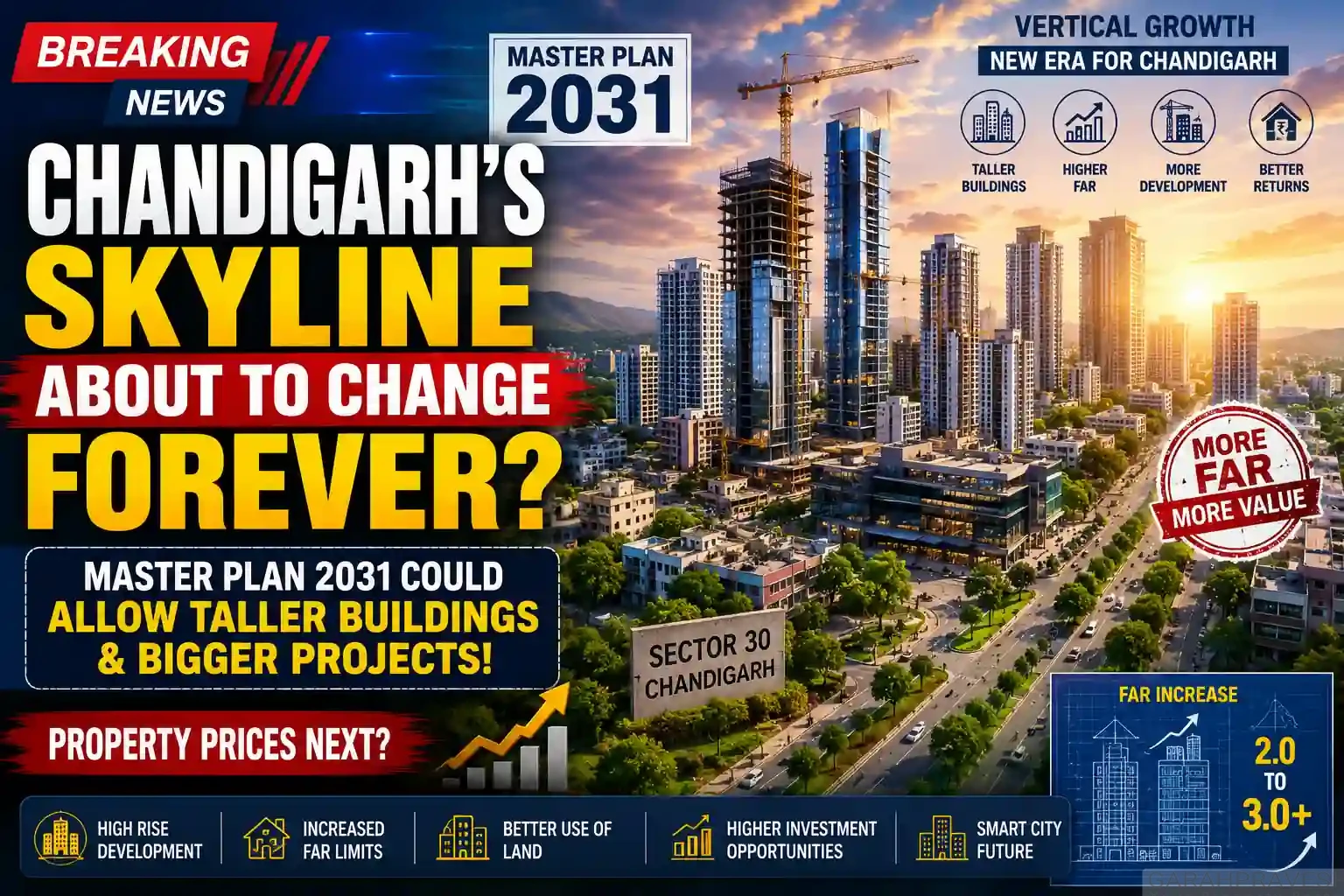
Chandigarh’s Biggest Real Estate Shake-Up? New Master Plan 2031 Draft May Allow Taller Buildings, Vertical Growth & Massive Development Push
Published By: News Desk – Garah Pravesh
Contact for Property Guidance & Transparent Deals: Garah Pravesh – 7087949434
Chandigarh Real Estate Set for a Massive Transformation? Here’s Everything You Need to Know About the New Master Plan 2031 Draft
Chandigarh’s skyline may soon witness one of the biggest transformations in its history. In a major development that could reshape the future of housing, commercial spaces, institutional infrastructure, and vertical development in the Tricity region, the Chandigarh Administration has released a draft amendment to the Chandigarh Master Plan 2031.
The proposed changes focus heavily on vertical growth, increased building heights, revised FAR norms, expanded institutional infrastructure, and redevelopment-friendly policies aimed at addressing land scarcity and growing urban demand.
According to the draft notification highlighted in the latest city reports, the administration is now shifting focus from “horizontal expansion” toward “vertical urban growth,” a move that could directly impact property prices, investment demand, redevelopment opportunities, rental markets, and future construction patterns in Chandigarh and nearby regions like Mohali, Zirakpur, Panchkula, and New Chandigarh.
This development is already becoming a major discussion point among:
- Real estate investors
- Builders and developers
- Industrial property buyers
- Commercial investors
- NRIs
- Educational institutions
- Homebuyers seeking future appreciation
If implemented fully, these amendments could significantly change the development potential of several sectors and peripheral areas.
Why Chandigarh Is Moving Toward Vertical Growth
Land Scarcity Is Becoming a Serious Urban Challenge
Chandigarh has long been known for its low-rise, highly planned urban architecture. However, with limited available land and rapidly increasing population pressure, authorities are now looking at vertical expansion as a practical urban planning solution.
The city’s growth limitations have created:
- Housing shortages
- Increased property rates
- Limited institutional expansion
- Pressure on infrastructure
- Reduced availability of large residential plots
The new draft seeks to address these concerns through strategic amendments.
Key Highlights of Chandigarh Master Plan 2031 Draft Amendments
1. Focus Shift: From Horizontal to Vertical Development
One of the biggest proposed changes is the administration’s clear shift toward:
“Vertical Growth Model”
This means:
- Taller buildings
- Increased floors
- Higher FAR allowances
- Better land utilization
- Multi-level infrastructure development
This approach is expected to improve urban density while maximizing limited land resources.
Sector-30 and Surrounding Areas May Witness Increased Building Heights
The report suggests that areas around Sector-30 could witness increased permissible building heights.
This could potentially:
- Increase redevelopment potential
- Raise future land values
- Encourage builder-floor and apartment projects
- Attract institutional and commercial interest
For investors, this becomes a key point because areas receiving height relaxations often experience:
- Faster appreciation
- Increased rental demand
- Commercial conversion opportunities
- Better redevelopment economics
Major Proposed Changes in Residential Housing Norms
New Housing Parameters for Manimajra Pocket No. 6 & Phase-3
The draft includes revised norms for:
- Building heights
- Population density
- Group housing FAR
- Cooperative housing societies
- Peripheral housing zones
Existing vs Proposed Highlights
| Parameter | Existing Norms | Proposed Amendments |
|---|---|---|
| Building Height | 4 Floors | Stilt + 5 Floors |
| Population Density | 175 persons/acre | Increased Density |
| Group Housing FAR | Limited | 3.0 FAR |
| Peripheral Housing FAR | Lower | 2.0 FAR |
| Cooperative Housing FAR | Restricted | 1.2 FAR |
These amendments indicate a major boost for residential development potential.
What Does Higher FAR Mean for Buyers and Investors?
Understanding FAR in Simple Terms
FAR (Floor Area Ratio) determines how much construction can be done on a plot.
Higher FAR generally means:
- More sellable area
- Larger apartment inventory
- Better project profitability
- More modern high-rise projects
- Greater redevelopment feasibility
For buyers, this can lead to:
- More housing options
- Modern amenities
- Better space utilization
- Competitive pricing in new launches
For developers, it can significantly improve project viability.
Industrial, Commercial & Institutional Spaces Also Get a Major Push
The draft doesn’t focus only on residential growth.
It also proposes major reforms for:
- Industrial zones
- Commercial spaces
- Religious institutions
- Educational infrastructure
Industrial Areas May Get Higher FAR
The draft proposes revised FAR norms in industrial areas.
Key Proposed Changes
| Area Type | Existing FAR | Proposed FAR |
|---|---|---|
| Industrial Areas Phase I & II | 1.0 | 2.0 |
| Industrial Worker Residences | 0% | 5% FAR Allowed |
| Institutional Areas | 0.5 | 2.5 |
| Religious Sites | 1.0 | 1.2 |
This could transform industrial zones into:
- Mixed-use economic hubs
- Better worker accommodation spaces
- Commercially viable redevelopment zones
Educational Institutions May Witness Major Expansion Opportunities
Schools & Colleges May Get Higher Construction Limits
Another important proposal relates to educational infrastructure.
The draft suggests:
- Increased ground coverage
- Higher FAR permissions
- Increased building heights
Proposed Changes for Educational Institutions
| Parameter | Existing | Proposed |
|---|---|---|
| Ground Coverage | 20% | 40% |
| School FAR | 0.75 | 1.5 |
| College FAR | 0.75 | 2.0 |
| Building Height | Limited | Up to 25.48 meters |
This may help:
- Schools expand vertically
- Colleges increase capacity
- Private educational groups invest in infrastructure
- Modern campus models emerge in Chandigarh
Why This Amendment Could Impact Property Prices Across Tricity
Real Estate Experts Expect Ripple Effect in Nearby Regions
Whenever Chandigarh witnesses a major planning policy shift, surrounding markets usually react quickly.
Areas likely to benefit:
- Zirakpur
- Mohali
- New Chandigarh
- Panchkula
- Aerocity
- IT City Mohali
- Mullanpur
Possible outcomes:
- Increased investor confidence
- Rise in plotted development demand
- More builder-floor launches
- Appreciation in redevelopment sectors
- Demand surge in commercial properties
Mullanpur May Emerge as a Major Future Growth Zone
The report also mentions development potential near Mullanpur.
With increasing land pressure inside Chandigarh, peripheral growth zones could become:
- Future residential hubs
- High-rise corridors
- Premium township locations
Experts already consider New Chandigarh and Mullanpur among the strongest future investment destinations in North India.
Chandigarh’s Urban Planning Philosophy Is Changing
Historically, Chandigarh followed:
- Low-density planning
- Wide roads
- Controlled heights
- Sector-based horizontal growth
But changing demographics and urban demand are forcing authorities to reconsider traditional planning limitations.
The proposed amendments indicate:
Chandigarh Is Preparing for a New Urban Era
This aligns with trends seen in:
- Gurgaon
- Noida
- Hyderabad
- Bengaluru
- Pune
Where vertical growth became essential for economic and residential expansion.
What Could Be the Biggest Winners If These Rules Are Approved?
1. Property Investors
Higher redevelopment potential can significantly improve land value.
2. Builders & Developers
Higher FAR improves project profitability and inventory capacity.
3. Commercial Property Owners
Vertical expansion often increases commercial demand.
4. Educational Institutions
Expanded infrastructure rights create long-term institutional benefits.
5. End Users & Homebuyers
More housing supply may improve availability and modern housing options.
Possible Concerns & Challenges
While the draft creates excitement, experts also point out challenges.
Infrastructure Pressure
Higher density may increase:
- Traffic congestion
- Parking demand
- Water usage
- Sewage load
- Electricity demand
Heritage Preservation Concerns
Chandigarh is globally recognized for its unique urban design inspired by Le Corbusier.
Critics argue that:
- Excessive high-rise growth may alter city character
- Urban aesthetics may change
- Sector uniformity could be impacted
Authorities will likely need balanced implementation.
Public Suggestions Invited for Draft Notification
The administration has reportedly invited public feedback regarding the proposed amendments.
Citizens, professionals, and stakeholders may submit:
- Suggestions
- Objections
- Recommendations
- email – ca-chd@chd.gov.in
This public participation phase could influence the final structure of the amendments.
What This Means for Homebuyers in 2026 and Beyond
Should Buyers Wait or Invest Now?
Many buyers are now evaluating:
- Whether property prices may rise after approval
- Which sectors may benefit most
- Whether redevelopment zones will appreciate faster
If vertical growth policies are approved, sectors with redevelopment potential could witness:
- Sharp demand increase
- Faster builder activity
- New premium project launches
Real Estate Market Sentiment Turning Aggressive
Property consultants across Tricity are already discussing:
- Future FAR-driven opportunities
- Builder acquisitions
- Institutional land demand
- Long-term appreciation corridors
Investors often enter markets early when policy-driven growth signals appear.
Important Advice for Buyers & Investors
Before investing based on policy news:
- Verify final approved notifications
- Check zoning regulations
- Confirm FAR permissions
- Understand legal compliances
- Review builder credibility
- Analyze infrastructure support
Avoid investing solely on rumors or unofficial market hype.
Looking for Property Opportunities in Chandigarh, Mohali, Zirakpur or New Chandigarh?
Get Verified & Transparent Property Guidance
For transparent property deals, investment guidance, builder-floor opportunities, premium residential projects, and future growth zone consultation:
Contact Garah Pravesh 📞 7087949434
Expert Market Analysis: Could Chandigarh Witness a Property Boom?
Many urban analysts believe the proposed amendments may trigger:
- New launch cycles
- Redevelopment-driven appreciation
- Institutional expansion
- Commercial demand growth
- Peripheral urbanization
If implemented strategically, Chandigarh could become:
One of North India’s Most Structured Vertical Growth Models
Frequently Asked Questions (FAQ)
Q1. What is Chandigarh Master Plan 2031?
The Chandigarh Master Plan 2031 is a long-term urban development framework that defines land use, housing, infrastructure, commercial planning, and future city growth policies.
Q2. What is the major change proposed in the new amendment draft?
The major focus is on shifting from horizontal growth to vertical development through higher building heights, increased FAR, and improved land utilization.
Q3. Which areas may benefit the most?
Potentially impacted areas include:
- Sector-30 vicinity
- Manimajra
- Peripheral housing zones
- Mullanpur
- New Chandigarh
- Industrial areas
Q4. Will property prices increase after these amendments?
If approved, increased redevelopment potential and investor interest may positively impact property values in selected zones.
Q5. What is FAR in real estate?
FAR (Floor Area Ratio) determines the total permissible construction area on a plot relative to plot size.
Q6. Can educational institutions build larger campuses now?
The draft proposes higher FAR, increased ground coverage, and taller structures for schools and colleges.
Q7. Is the amendment officially approved?
At present, it is a draft amendment proposal. Final implementation will depend on approvals and public consultation outcomes.
Q8. Why is Chandigarh promoting vertical growth?
Due to limited land availability, increasing population demand, and the need for better urban infrastructure optimization.
Disclaimer
This article is intended purely for informational and news-sharing purposes based on publicly circulated draft amendment discussions and reported urban planning updates. Policies, FAR norms, height permissions, zoning regulations, and development approvals are subject to change by competent authorities at any stage. Readers, investors, buyers, institutions, and developers are strongly advised to independently verify all legal, technical, financial, and regulatory details from official government departments, urban planning authorities, architects, legal advisors, and approved notifications before making any property-related decisions. The publisher, author, and associated entities do not assume responsibility or legal liability for investment outcomes, policy interpretation differences, market fluctuations, or any decisions taken based on this article.